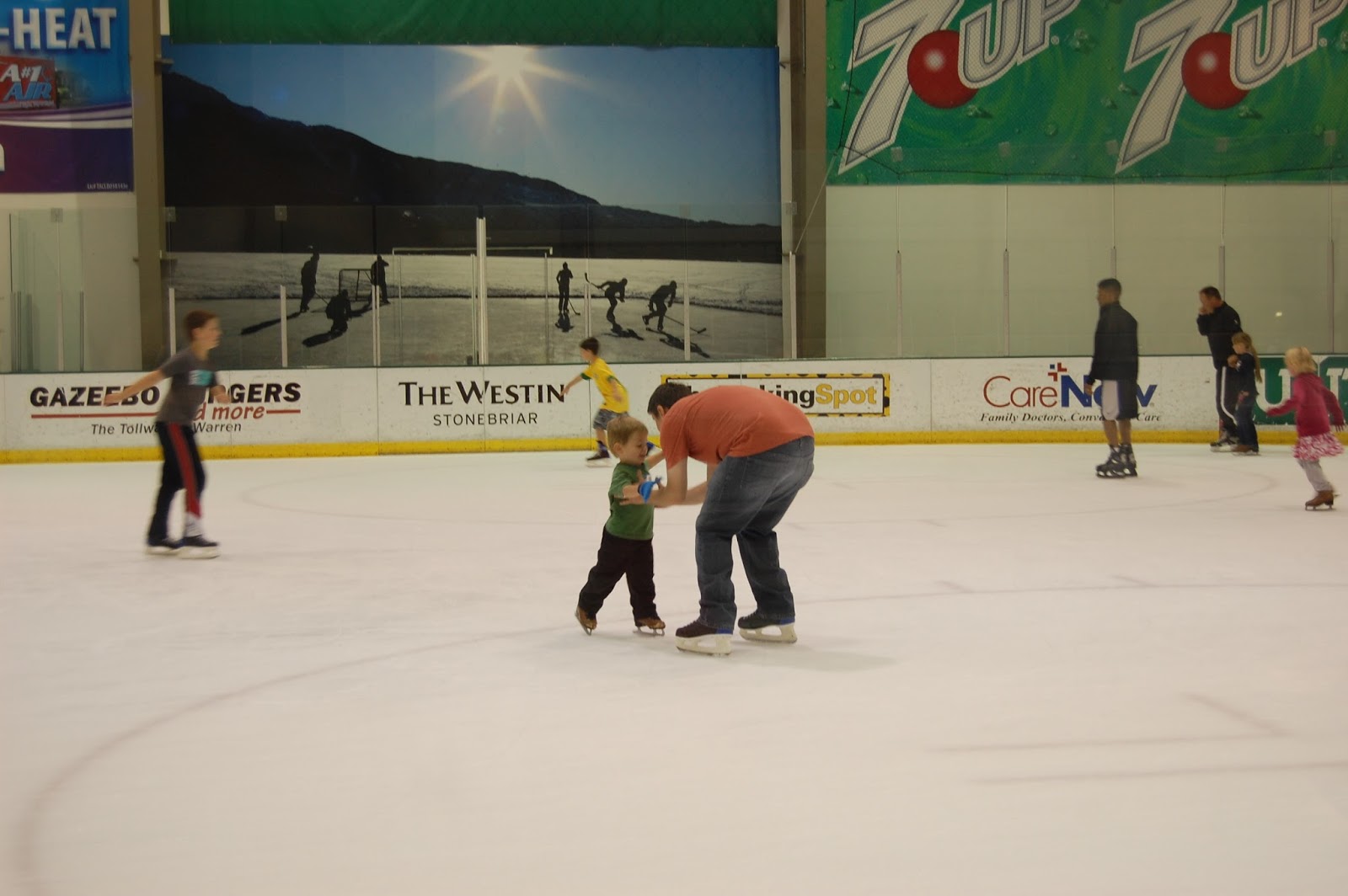
It's hot still. There is nothing like going ice skating during record hot temperatures. Our kids love it and you can see how much better they are getting.
They start with a quick trip around the ice with wonderful husband. They hold his hands and just get a feel for the skates on ice.
Sweet Daughter is quickly on her own. Little Miss Independent doesn't want to hold hands or have help.
It takes a little more convincing, but Sweet Son is also willing to skate on his own as long as Daddy is close.
She could have skated straight into his arms... I think she chose to go past him while smiling. (She is so my daughter.)
The best part? Each time one of them comes off the ice, the other one greets them with a hug. It's like they have been reunited after being away for months rather than minutes.
They have actually gotten good enough that Wonderful Husband can take them both out at the same time. Maybe one day I will learn how to skate...
Showing posts with label P.E.. Show all posts
Monday, September 2, 2013
Thursday, August 8, 2013
The Importance of Early Education
So my post on Tuesday was about how to develop the brain for better reading success. Now I'm going to do a post on why your child doesn't need to know how to read early.
Kids were tested going into Kindergarten on their knowledge of reading, Math, Science, and Social Studies. What was the best predictor of later reading and Math tests (2nd grade and up)? Science and Social Studies, in that order. Kindergarten reading was not even correlated to 2nd grade reading. Early reading certainly didn't cause higher reading scores. It is much more important to do Science with your kids than any other subject when they are young. This is great because most young kids would rather do Science than reading anyway. Everyone's happy! Also interesting is that early reading doesn't improve later Science and Social Studies scores. Since those subjects are most traditionally taught through reading, I found that interesting. So far the research hasn't figured out why, but still fascinating.
The best way to improve Math scores is going to surprise you. Fine motor skills help with Math. The larger the fine motor deficit, the more impaired later Math becomes. This is most obvious when replicating figures or models, but is true for all areas of Math. They tested many different ways to improve Math scores and the top interventions are: drawing (but not coloring), Legos, fuse beads, pattern blocks, Montessori triangles, puzzles, paper folding, blocks, knob cylinders, and Colorforms. No worksheets, flashcards, or tutoring made the list. Kids tend to shut down when forced to do something they think they aren't good at, but hand them a bucket of Legos or teach them paper folding and they are willing and successful.
Now for something that makes me feel old. These studies weren't just done with young children. These studies went all the way through college students. At the beginning and the end of the college student study they needed a novel way to test their ability to do mental rotation. Something the kids hadn't done before and were unlikely to practice in between the two tests. They used Tetris. For those of you who are around my age you just freaked out a little that college students have never played Tetris. I was presented with this information at a conference. The group of young guys in the row in front of me spent about 5 minutes debating what Tetris is before using their smart phones to look it up. They decided it must be a game for old people.
It's well known that the current educational policy is dill and kill. Everyone says they want their kids to have critical thinking skills. You need to know that these are learned before/after and outside school, usually through play. Music, sports, fine motor, problem solving, etc. It's also important to realize that most colleges care more about these activities than you might expect. When looking at two kids with identical grades and test scores the one that will stand out is the one who was involved in things outside of school. This is also one reasons the homeschooling movement is growing in the United States.
Kids were tested going into Kindergarten on their knowledge of reading, Math, Science, and Social Studies. What was the best predictor of later reading and Math tests (2nd grade and up)? Science and Social Studies, in that order. Kindergarten reading was not even correlated to 2nd grade reading. Early reading certainly didn't cause higher reading scores. It is much more important to do Science with your kids than any other subject when they are young. This is great because most young kids would rather do Science than reading anyway. Everyone's happy! Also interesting is that early reading doesn't improve later Science and Social Studies scores. Since those subjects are most traditionally taught through reading, I found that interesting. So far the research hasn't figured out why, but still fascinating.
The best way to improve Math scores is going to surprise you. Fine motor skills help with Math. The larger the fine motor deficit, the more impaired later Math becomes. This is most obvious when replicating figures or models, but is true for all areas of Math. They tested many different ways to improve Math scores and the top interventions are: drawing (but not coloring), Legos, fuse beads, pattern blocks, Montessori triangles, puzzles, paper folding, blocks, knob cylinders, and Colorforms. No worksheets, flashcards, or tutoring made the list. Kids tend to shut down when forced to do something they think they aren't good at, but hand them a bucket of Legos or teach them paper folding and they are willing and successful.
Now for something that makes me feel old. These studies weren't just done with young children. These studies went all the way through college students. At the beginning and the end of the college student study they needed a novel way to test their ability to do mental rotation. Something the kids hadn't done before and were unlikely to practice in between the two tests. They used Tetris. For those of you who are around my age you just freaked out a little that college students have never played Tetris. I was presented with this information at a conference. The group of young guys in the row in front of me spent about 5 minutes debating what Tetris is before using their smart phones to look it up. They decided it must be a game for old people.
It's well known that the current educational policy is dill and kill. Everyone says they want their kids to have critical thinking skills. You need to know that these are learned before/after and outside school, usually through play. Music, sports, fine motor, problem solving, etc. It's also important to realize that most colleges care more about these activities than you might expect. When looking at two kids with identical grades and test scores the one that will stand out is the one who was involved in things outside of school. This is also one reasons the homeschooling movement is growing in the United States.
Monday, July 29, 2013
The importance of working memory
As I mentioned in the executive function post, working memory is extremely important. Working memory is the best predictor of school success. It is both academic and social. So, what else do we know about working memory?
High IQ does not equal high working memory. The opposite is also true, high working memory doesn't equal high IQ. While most IQ tests are sensitive to socioeconomic status (SES), working memory is not. For example, one section of most IQ tests for children is on general knowledge. If you ask a child "What is a police officer?" the correct answer would be something along the lines of "someone who helps people." An incorrect answer would be "someone who takes my Daddy away." Clearly this is measuring experience, not intelligence.
There are ways to improve working memory. It all starts with diet and exercise. I've address the importance of exercise on the brain already. So which foods are best to include in your diet? Dairy, berries, herbs, and foods with omega3 and dha have all been proven beneficial specifically for working memory. Foods that will have a negative impact are processed and contain high amounts of sugar, fat, and chemicals. One Organic Mama was kind enough to write a guest post for me on healthy living.
Once you have addressed the diet and exercise components, the other way to improve working memory is through proprioception training. In fact, proprioception training for just one day shows and increase in working memory by 50% and it lasts many months. As with anything, the more you do it the better the results. Proprioception is the ability to sense the position, location, orientation, and movement of the body and its parts. Proprioception training is all about balance and body awareness. It includes things like walking on a balance beam with your eyes closed, jumping to a target with your eyes closed, crawling on a balance beam, and running.
High IQ does not equal high working memory. The opposite is also true, high working memory doesn't equal high IQ. While most IQ tests are sensitive to socioeconomic status (SES), working memory is not. For example, one section of most IQ tests for children is on general knowledge. If you ask a child "What is a police officer?" the correct answer would be something along the lines of "someone who helps people." An incorrect answer would be "someone who takes my Daddy away." Clearly this is measuring experience, not intelligence.
There are ways to improve working memory. It all starts with diet and exercise. I've address the importance of exercise on the brain already. So which foods are best to include in your diet? Dairy, berries, herbs, and foods with omega3 and dha have all been proven beneficial specifically for working memory. Foods that will have a negative impact are processed and contain high amounts of sugar, fat, and chemicals. One Organic Mama was kind enough to write a guest post for me on healthy living.
Once you have addressed the diet and exercise components, the other way to improve working memory is through proprioception training. In fact, proprioception training for just one day shows and increase in working memory by 50% and it lasts many months. As with anything, the more you do it the better the results. Proprioception is the ability to sense the position, location, orientation, and movement of the body and its parts. Proprioception training is all about balance and body awareness. It includes things like walking on a balance beam with your eyes closed, jumping to a target with your eyes closed, crawling on a balance beam, and running.
Tuesday, July 23, 2013
Exercise and the Brain
I wrote about this topic more than a year ago, but I wanted to post again with the additional research.
The importance of physical exercise on your neurological health is fascinating to me, so when I'm attending a conference I tend to chose sessions that include this topic when possible. One of my favorite speakers is Dr. Kenneth Kosik. (You may notice I referred to his research in the post linked above also.) He does a lot of research on Alzheimer's and brain health. Here are some of the notes I wrote down from his session.
If you have more education and a more demanding job, it protects you against Alzheimer's.
Alzheimer's, heart attack, and stroke have many of the same risk factors.
Vascular blood vessels in the brain would be 500 miles long if stretched out.
Childhood cardiovascular health impacts the blood vessels in the brain.
70% of 40 year olds have affected blood vessels in the USA.
Children should not ever have more than 50g/day of sugar. (A juice box is 25g.)
Travel reduces risk of dementia, as does socializing, knitting, and gardening.
Biking, swimming, and golf don't reduce risk of dementia.
Dancing and playing instruments lowers dementia risk.
Cognitively, it's better to follow than to lead when dancing.
If you notice, taking care of your heart and physical health is obviously one of the most important factors in keeping your brain healthy. Nutrition and exercise reduce your risk of cardiovascular problems and mental problems. Trying things that are new and challenging, especially facing the unexpected (traveling, socializing), should be encouraged at all stages of life. I was disappointed that biking and swimming aren't more helpful since I enjoy those. I will continue to play instruments and encourage my kids to do so. I dance like a white girl with two left feet, so I will avoid that one for now. haha
I also attended a lecture by Dr. John Ratey (Harvard Medical School). He shared how humans are de-evolving. We sit in front of screens hunched over and it's making us much worse off. He is a big proponent of the FitDesk
if you have to do computer work. Here are some of my notes from his speech.
It's better to wear out your body and mind than to rust.
Running will get you results in half the time of walking.
To add 3 years to your life run 100 min/week or walk 200 min/week.
Running is the best exercise for neurological health.
The computer offers hypernormal stimuli.
Fitness increases neurons and connectivity in the brain.
Exercise is as good as Zoloft to treat depression.
Exercise is the equivalent of a little Prozac and a little Adderall.
Running increases your endocannabinoids. (like marijuana)
A PE teacher gave grades based on how long students' heart rates were in the target zone and there was an 83% drop in disciplan referrals.
Teachers should offer a time in instead of a time out (run, bike, etc) in order to turn the brain back on.
Improving cardio fitness improves IQ.
Strength training improves physical health, but not mental.
I should note here that I hate running, so hearing that was the best thing I could do for myself mentally was a major disappointment. However, it was also the push I needed. As I write this I'm in week 4 of a couch to 5k program. By the time this is published I hope to have completed it. I still hate running, but after seeing the evidence, I feel the need to run. I would love a FitDesk
, but don't have the money or a place to put it. I like the idea of PE grades being based on something that everyone can achieve with effort.
So, has any of this information made you want to start exercising?
The importance of physical exercise on your neurological health is fascinating to me, so when I'm attending a conference I tend to chose sessions that include this topic when possible. One of my favorite speakers is Dr. Kenneth Kosik. (You may notice I referred to his research in the post linked above also.) He does a lot of research on Alzheimer's and brain health. Here are some of the notes I wrote down from his session.
If you have more education and a more demanding job, it protects you against Alzheimer's.
Alzheimer's, heart attack, and stroke have many of the same risk factors.
Vascular blood vessels in the brain would be 500 miles long if stretched out.
Childhood cardiovascular health impacts the blood vessels in the brain.
70% of 40 year olds have affected blood vessels in the USA.
Children should not ever have more than 50g/day of sugar. (A juice box is 25g.)
Travel reduces risk of dementia, as does socializing, knitting, and gardening.
Biking, swimming, and golf don't reduce risk of dementia.
Dancing and playing instruments lowers dementia risk.
Cognitively, it's better to follow than to lead when dancing.
If you notice, taking care of your heart and physical health is obviously one of the most important factors in keeping your brain healthy. Nutrition and exercise reduce your risk of cardiovascular problems and mental problems. Trying things that are new and challenging, especially facing the unexpected (traveling, socializing), should be encouraged at all stages of life. I was disappointed that biking and swimming aren't more helpful since I enjoy those. I will continue to play instruments and encourage my kids to do so. I dance like a white girl with two left feet, so I will avoid that one for now. haha
I also attended a lecture by Dr. John Ratey (Harvard Medical School). He shared how humans are de-evolving. We sit in front of screens hunched over and it's making us much worse off. He is a big proponent of the FitDesk
It's better to wear out your body and mind than to rust.
Running will get you results in half the time of walking.
To add 3 years to your life run 100 min/week or walk 200 min/week.
Running is the best exercise for neurological health.
The computer offers hypernormal stimuli.
Fitness increases neurons and connectivity in the brain.
Exercise is as good as Zoloft to treat depression.
Exercise is the equivalent of a little Prozac and a little Adderall.
Running increases your endocannabinoids. (like marijuana)
A PE teacher gave grades based on how long students' heart rates were in the target zone and there was an 83% drop in disciplan referrals.
Teachers should offer a time in instead of a time out (run, bike, etc) in order to turn the brain back on.
Improving cardio fitness improves IQ.
Strength training improves physical health, but not mental.
I should note here that I hate running, so hearing that was the best thing I could do for myself mentally was a major disappointment. However, it was also the push I needed. As I write this I'm in week 4 of a couch to 5k program. By the time this is published I hope to have completed it. I still hate running, but after seeing the evidence, I feel the need to run. I would love a FitDesk
So, has any of this information made you want to start exercising?
Tuesday, March 20, 2012
The importance of exercise
I'm sure you know the importance of exercise for physical health. This is going to be about the importance of exercise for your mental health (with a few physical health tips thrown in).
It has been proven that exercise in kids increases their perception, creativity, concentration, and IQ. That's impressive. How many other things can do all of that at the same time? More importantly, the research shows that early life matters. The earlier in life that exercise happens, the better the health and cognitive benefits. What would take a 40 year old 2 hours of exercise to accomplish can be done in 30 minutes by a toddler. Frustrating as an adult, but this is a clear sign of how to help your child.
Disease risks result from an accumulation of experiences according to Dr. Kosik, the co-director of the Neuroscience Research Institute at the University of California, Santa Barbara. When you think about the opposite, it makes sense. If you are exposed to a toxic substance in small amounts throughout life it starts to add up. So, while you might not see a problem at first, you will eventually have to deal with the accumulation of the toxin in your body. Therefore, exercise also helps the accumulation of positive, disease fighting processes in the body. Throughout life your education, diet, exercise, and many other factors can shift your health trajectory to a better (or worse) one.
An increase in aerobic fitness was studied in students in the 3rd - 9th grades. The increase in fitness aligned with an increase in Reading and Math scores. If you want better test scores, don't get rid of P.E. and recess. Teachers have been able to see the difference in their students and knew this instinctively, but now there's neuroscience to back it up.
Since I have a family history of Alzheimer's disease, I've also been following the research on how to prevent or treat this cognitive disorder. The most effective treatment they have found so far? Exercise. It's showing better results than any of the medications. This is not to say that we shouldn't treat with medication, but we can't ignore the importance of treating with exercise as well. They have also been studying the brain scans of people at risk for Alzheimer's and discovered that the disease actually starts 10-30 years before the first symptoms appear outwardly. If you know it's starting before symptoms, you can treat early and slow the progression. Granted, most people don't get brain scans before having neurological symptoms. This is why it is even more important to exercise as an adult to prevent cognitive decline. An absence of cognitive challenges has also been proven to increase the risk of cognitive decline. Most people pick 1-2 ways to challenge themselves cognitively and stick with them throughout life. You might play chess, solve crossword puzzles, or play an instrument. While all of these are great, if you have been doing them for years, you will not be building new brain mapping. Try something you aren't as comfortable with - learn a new language, take a painting class, or study photography. It's always good to start learning something new, but the most important time to learn these things to prevent (or slow) Alzheimer's is in your 40's-60's.
Random fact that is mostly unrelated to this post: Some savants have no visible differences in their brain scans from the rest of us "normal" people.
It has been proven that exercise in kids increases their perception, creativity, concentration, and IQ. That's impressive. How many other things can do all of that at the same time? More importantly, the research shows that early life matters. The earlier in life that exercise happens, the better the health and cognitive benefits. What would take a 40 year old 2 hours of exercise to accomplish can be done in 30 minutes by a toddler. Frustrating as an adult, but this is a clear sign of how to help your child.
Grandma playing with our feet is funny
Disease risks result from an accumulation of experiences according to Dr. Kosik, the co-director of the Neuroscience Research Institute at the University of California, Santa Barbara. When you think about the opposite, it makes sense. If you are exposed to a toxic substance in small amounts throughout life it starts to add up. So, while you might not see a problem at first, you will eventually have to deal with the accumulation of the toxin in your body. Therefore, exercise also helps the accumulation of positive, disease fighting processes in the body. Throughout life your education, diet, exercise, and many other factors can shift your health trajectory to a better (or worse) one.
Wee!
An increase in aerobic fitness was studied in students in the 3rd - 9th grades. The increase in fitness aligned with an increase in Reading and Math scores. If you want better test scores, don't get rid of P.E. and recess. Teachers have been able to see the difference in their students and knew this instinctively, but now there's neuroscience to back it up.
Hi there!
Since I have a family history of Alzheimer's disease, I've also been following the research on how to prevent or treat this cognitive disorder. The most effective treatment they have found so far? Exercise. It's showing better results than any of the medications. This is not to say that we shouldn't treat with medication, but we can't ignore the importance of treating with exercise as well. They have also been studying the brain scans of people at risk for Alzheimer's and discovered that the disease actually starts 10-30 years before the first symptoms appear outwardly. If you know it's starting before symptoms, you can treat early and slow the progression. Granted, most people don't get brain scans before having neurological symptoms. This is why it is even more important to exercise as an adult to prevent cognitive decline. An absence of cognitive challenges has also been proven to increase the risk of cognitive decline. Most people pick 1-2 ways to challenge themselves cognitively and stick with them throughout life. You might play chess, solve crossword puzzles, or play an instrument. While all of these are great, if you have been doing them for years, you will not be building new brain mapping. Try something you aren't as comfortable with - learn a new language, take a painting class, or study photography. It's always good to start learning something new, but the most important time to learn these things to prevent (or slow) Alzheimer's is in your 40's-60's.
These chairs aren't comfortable.
Random fact that is mostly unrelated to this post: Some savants have no visible differences in their brain scans from the rest of us "normal" people.
Subscribe to:
Posts (Atom)