As I mentioned in the executive function post, working memory is extremely important. Working memory is the best predictor of school success. It is both academic and social. So, what else do we know about working memory?
High IQ does not equal high working memory. The opposite is also true, high working memory doesn't equal high IQ. While most IQ tests are sensitive to socioeconomic status (SES), working memory is not. For example, one section of most IQ tests for children is on general knowledge. If you ask a child "What is a police officer?" the correct answer would be something along the lines of "someone who helps people." An incorrect answer would be "someone who takes my Daddy away." Clearly this is measuring experience, not intelligence.
There are ways to improve working memory. It all starts with diet and exercise. I've address the importance of exercise on the brain already. So which foods are best to include in your diet? Dairy, berries, herbs, and foods with omega3 and dha have all been proven beneficial specifically for working memory. Foods that will have a negative impact are processed and contain high amounts of sugar, fat, and chemicals. One Organic Mama was kind enough to write a guest post for me on healthy living.
Once you have addressed the diet and exercise components, the other way to improve working memory is through proprioception training. In fact, proprioception training for just one day shows and increase in working memory by 50% and it lasts many months. As with anything, the more you do it the better the results. Proprioception is the ability to sense the position, location, orientation, and movement of the body and its parts. Proprioception training is all about balance and body awareness. It includes things like walking on a balance beam with your eyes closed, jumping to a target with your eyes closed, crawling on a balance beam, and running.

Showing posts with label head. Show all posts
Showing posts with label head. Show all posts
Monday, July 29, 2013


Thursday, June 27, 2013
What is Executive Function?
I attended a multi-day conference on executive function and how it relates to school success. Of course the first place to start should be to define executive function. Here's the problem, no one agrees. There are more than 30 credible definitions and 100s of less than credible definitions. So, here are the most common items included by various definitions:
Inhibition (self-control)
Working Memory (spatial and verbal)
Cognitive Flexibility
If you ask any teacher, these are the types of skills that are the most important in the classroom. It's much easier to teach a child to read than to teach a child self-control. Every Kindergarten teacher would rather have a class full of kids who have self-control, a good working memory, and cognitive flexibility than having a classroom full of kids who can read and do math above grade level. When you are pushing your child to be more academic stop and think about the things that are more important.
Let's look at each of these one at a time. Inhibition is more than just not hitting the jerk next to you (though that is certainly part of it). It's also controlling when you talk and what you say (I'm still working on that one). You also need to be able to inhibit the tendency to be distracted, to quit if bored or offered temptation, etc. I remember a band director once telling us the most difficult parts of any piece of music are the rests. That's the inhibition part of executive function.
Working memory is actually one of the best predictors of academic success. How much you can hold in your working memory and how you are able to manipulate it is pretty much how we define school success. This relates to reading graphs, reading books, following directions, having a discussion, and being able to consider things from multiple perspectives. Without working memory you can't make connections to other things, which is how we build neural connections in the brain. This is how we build all knowledge.
Cognitive flexibility is the most difficult part of executive function. This is being able to make mental, physical, and behavioral transitions. This is knowing the rules are different at school than at home. Pretty much every place we go, the rules are at least slightly different. Even within one place the rules can be different - at home with a babysitter versus a parent - at school in music class versus on the playground. We all know kids, and some adults, who struggle with these types of transitions. Cognitive flexibility also helps with being able to understand multiple perspectives. This is what allows us to have "outside the box" thinking and is crucial for problem solving.
Think of executive function as the director of an orchestra. Your brain does many different things, but the executive function tells it what to do and when. Many disorders start with executive dysfunction - ADHD, Tourett's Syndrome, Obsessive-Compulsive Disorder, Depression, Autism, Learning Disabilities, Anxiety, etc. Ideally, we would test for executive function so we could help improve in all of these areas. Only, how do you test for something you can't define? This is the problem we are currently trying to address. There are some executive function evaluations on the market, however they don't cover most of what we actually want to know. I heard one analogy that it would be like giving an eye test and a coordination test and using that to determine who can drive. Those things are both needed, but there is so much more to driving, just as there is much more to executive function than the current tests evaluate.Follow my blog with Bloglovin
Inhibition (self-control)
Working Memory (spatial and verbal)
Cognitive Flexibility
If you ask any teacher, these are the types of skills that are the most important in the classroom. It's much easier to teach a child to read than to teach a child self-control. Every Kindergarten teacher would rather have a class full of kids who have self-control, a good working memory, and cognitive flexibility than having a classroom full of kids who can read and do math above grade level. When you are pushing your child to be more academic stop and think about the things that are more important.
Let's look at each of these one at a time. Inhibition is more than just not hitting the jerk next to you (though that is certainly part of it). It's also controlling when you talk and what you say (I'm still working on that one). You also need to be able to inhibit the tendency to be distracted, to quit if bored or offered temptation, etc. I remember a band director once telling us the most difficult parts of any piece of music are the rests. That's the inhibition part of executive function.
Working memory is actually one of the best predictors of academic success. How much you can hold in your working memory and how you are able to manipulate it is pretty much how we define school success. This relates to reading graphs, reading books, following directions, having a discussion, and being able to consider things from multiple perspectives. Without working memory you can't make connections to other things, which is how we build neural connections in the brain. This is how we build all knowledge.
Cognitive flexibility is the most difficult part of executive function. This is being able to make mental, physical, and behavioral transitions. This is knowing the rules are different at school than at home. Pretty much every place we go, the rules are at least slightly different. Even within one place the rules can be different - at home with a babysitter versus a parent - at school in music class versus on the playground. We all know kids, and some adults, who struggle with these types of transitions. Cognitive flexibility also helps with being able to understand multiple perspectives. This is what allows us to have "outside the box" thinking and is crucial for problem solving.
Think of executive function as the director of an orchestra. Your brain does many different things, but the executive function tells it what to do and when. Many disorders start with executive dysfunction - ADHD, Tourett's Syndrome, Obsessive-Compulsive Disorder, Depression, Autism, Learning Disabilities, Anxiety, etc. Ideally, we would test for executive function so we could help improve in all of these areas. Only, how do you test for something you can't define? This is the problem we are currently trying to address. There are some executive function evaluations on the market, however they don't cover most of what we actually want to know. I heard one analogy that it would be like giving an eye test and a coordination test and using that to determine who can drive. Those things are both needed, but there is so much more to driving, just as there is much more to executive function than the current tests evaluate.Follow my blog with Bloglovin
Monday, February 4, 2013
Ohio and a hair cut
We (Sweet Son and I) are reading a book about dinosaurs. He looks at me with
that look of complete confusion and asks: "Can we go to Ohio?"
Me: "Ohio? You want to go to Ohio? Why?"
Son: "Ohio is next to the race car state."
Me: "The race car state?"
Son: "Indiana has race cars."
Me: "You want to go to Ohio because it is next to Indiana, which has race cars?"
Son: "Go to Ohio tomorrow?"
Once again I have disappointed my son. We will not be going to Ohio tomorrow (or anytime in the near future). I also have no idea where he comes up with this stuff. We do have a couple of books about Texas, but I've certainly never taught him about Ohio or Indiana. I'm guessing he's learning it at school. Must be time to bring out our US state puzzle and some more books since he's interested.


Me: "Ohio? You want to go to Ohio? Why?"
Son: "Ohio is next to the race car state."
Me: "The race car state?"
Son: "Indiana has race cars."
Me: "You want to go to Ohio because it is next to Indiana, which has race cars?"
Son: "Go to Ohio tomorrow?"
Once again I have disappointed my son. We will not be going to Ohio tomorrow (or anytime in the near future). I also have no idea where he comes up with this stuff. We do have a couple of books about Texas, but I've certainly never taught him about Ohio or Indiana. I'm guessing he's learning it at school. Must be time to bring out our US state puzzle and some more books since he's interested.


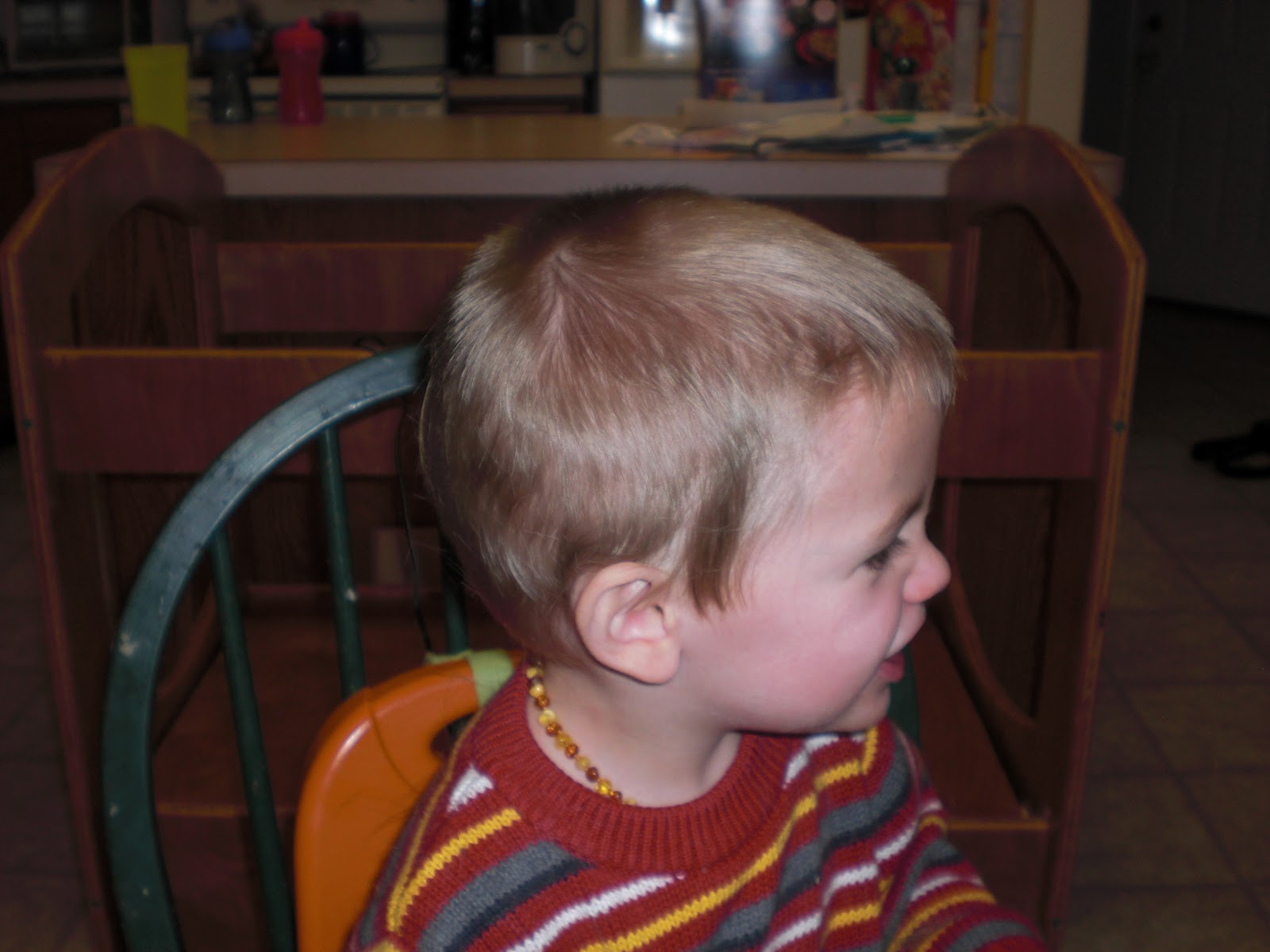
These are the before photos.
During
How do we get him to hold still and let us cut his hair? We give him a turn, which does occasionally leave a strange mark across his head, but overall works well.
The Process - haha

After
Monday, July 25, 2011
Chiropractic Care
During pregnancy I had awful back pain. It's like I was huge and carrying twins. I remember calling a chiropractor who specializes in pregnant women and begging for her to get me in that day. She was able to work me in the next day and I was amazed at how much it helped. I saw her regularly for the rest of the pregnancy and it helped a ton until about 37 weeks and at that point I just lived with the back pain. I'm so glad I didn't live with the pain for months.

A few months after the kids were born their pediatrician commented on their head shape and our son's lack of bending. She referred us to another chiropractor. There were two main issues.
The first was head shape. While my son's head shape wasn't perfectly round, it wasn't too extreme. My daughter's head was clearly misshapen. It was flat - not even slightly rounded - in the back. I'm not talking about one little flat spot, the entire back of her head was flat. We didn't get a lot of great photos, but hopefully these will help you see what I'm talking about. We rarely took photos of the back of the kids heads.


The chiropractor the pediatrician referred us to started treating the head shape 4 times a week. As it got better, it did back off to 3, 2, and 1 time a week. By the very end we were only going once every 2 weeks before she released us from her care. Our daughter required more than 90 visits over 10 months to correct her head shape. This was a huge commitment from us, but now her head is round and you can't tell any difference.

Many babies have flat spots on their head and are treated with the large helmets. The most common in the US is the doc band. These are expensive, often not covered by insurance, and only prevent more flattening rather than correcting what has already happened. Chiropractic care was more effective and cheaper (though still not cheap or covered by insurance). I highly recommend chiropractic care for anyone who has a baby with a flat spot on their head.
While my son's head had a flat spot that we did get corrected, his biggest issues was his stiffness. He was diagnosed as hypertonic. Basically, he was stiff as a board. He didn't bend and when forced to bend he would cry and be upset. The first chiropractor treated him, but it just wasn't helping. She even told us he would probably never walk or bend since she couldn't help him. We went back to the pediatrician who wanted us to try another type of chiropractic treatment. She gave us another name and we called that chiropractor. After a phone consultation, we realized we could not make the intensive schedule and cost work for our family. I called the chiropractor that I had seen during pregnancy and discovered she did the same type of treatments for babies and we could afford her!

We started with weekly appointments and then backed off two every two weeks. There were a few times we were even able to only go to once every three weeks. While he is still being treated for this, we see a huge difference with each treatment. Before a treatment he is stiff and it hurts him to bend. After a treatment he can not only easily bend, but he's happier. As he gets older and is able to talk to us more we are beginning to get a better picture of what is happening. He will complain that his knee hurts the day before he stops bending the knee for example. He is walking, running, climbing, and everything else without limit. He has met each milestone differently, but has always been able to meet them.


The most difficult part is watching him and knowing he can't do it the "easy" way other children can. When he was learning to pull up he would go from laying flat on his stomach to pulling himself up with his arms without ever bending at the waist. It looked goofy, but he was so proud of being able to stand. Our daughter, by contrast, followed the more typical pattern of going from laying to sitting, to pulling up, to standing. As I said, he is still receiving treatments so we don't know what the long term solution is yet. He also has other issues that we are dealing with to help him be happy and successful for the rest of his life.

I am so thankful for the chiropractic care we have and are still receiving. It has quite literally changed our lives.

No wonder my back was hurting
A few months after the kids were born their pediatrician commented on their head shape and our son's lack of bending. She referred us to another chiropractor. There were two main issues.
The first was head shape. While my son's head shape wasn't perfectly round, it wasn't too extreme. My daughter's head was clearly misshapen. It was flat - not even slightly rounded - in the back. I'm not talking about one little flat spot, the entire back of her head was flat. We didn't get a lot of great photos, but hopefully these will help you see what I'm talking about. We rarely took photos of the back of the kids heads.

The entire back of her head was flat.

Another angle of the flatness

Halfway through treatments

After 6 months of treatments. Slight curve noticeable now
The chiropractor the pediatrician referred us to started treating the head shape 4 times a week. As it got better, it did back off to 3, 2, and 1 time a week. By the very end we were only going once every 2 weeks before she released us from her care. Our daughter required more than 90 visits over 10 months to correct her head shape. This was a huge commitment from us, but now her head is round and you can't tell any difference.

No more treatments!!
Many babies have flat spots on their head and are treated with the large helmets. The most common in the US is the doc band. These are expensive, often not covered by insurance, and only prevent more flattening rather than correcting what has already happened. Chiropractic care was more effective and cheaper (though still not cheap or covered by insurance). I highly recommend chiropractic care for anyone who has a baby with a flat spot on their head.
While my son's head had a flat spot that we did get corrected, his biggest issues was his stiffness. He was diagnosed as hypertonic. Basically, he was stiff as a board. He didn't bend and when forced to bend he would cry and be upset. The first chiropractor treated him, but it just wasn't helping. She even told us he would probably never walk or bend since she couldn't help him. We went back to the pediatrician who wanted us to try another type of chiropractic treatment. She gave us another name and we called that chiropractor. After a phone consultation, we realized we could not make the intensive schedule and cost work for our family. I called the chiropractor that I had seen during pregnancy and discovered she did the same type of treatments for babies and we could afford her!

One baby bends and one doesn't
We started with weekly appointments and then backed off two every two weeks. There were a few times we were even able to only go to once every three weeks. While he is still being treated for this, we see a huge difference with each treatment. Before a treatment he is stiff and it hurts him to bend. After a treatment he can not only easily bend, but he's happier. As he gets older and is able to talk to us more we are beginning to get a better picture of what is happening. He will complain that his knee hurts the day before he stops bending the knee for example. He is walking, running, climbing, and everything else without limit. He has met each milestone differently, but has always been able to meet them.

Babies should not be able to stand unassisted at 6 months

Only one could bend and sit
The most difficult part is watching him and knowing he can't do it the "easy" way other children can. When he was learning to pull up he would go from laying flat on his stomach to pulling himself up with his arms without ever bending at the waist. It looked goofy, but he was so proud of being able to stand. Our daughter, by contrast, followed the more typical pattern of going from laying to sitting, to pulling up, to standing. As I said, he is still receiving treatments so we don't know what the long term solution is yet. He also has other issues that we are dealing with to help him be happy and successful for the rest of his life.

Happy while crawling after a treatment
I am so thankful for the chiropractic care we have and are still receiving. It has quite literally changed our lives.
Subscribe to:
Posts (Atom)